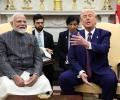
Miller said that US President Donald Trump has a 'tremendous' relationship with Prime Minister Narendra Modi, and that the peace options for the region are on the table.
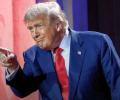
Since May 10, when Trump announced on social media that India and Pakistan had agreed to a "full and immediate" ceasefire after a "long night" of talks mediated by Washington, he has repeated his claim on several occasions.

Four senior Indian-origin persons were killed in a car crash in West Virginia. The victims were reported missing from Buffalo, New York, and their vehicle was found off a steep embankment.

Starting August 1, 2025, all consular services, including passport, visa, OCI, surrender certificate, life certificate, birth/marriage certificate, police clearance, attestations, and more, will be provided exclusively through VFS Global Centres.
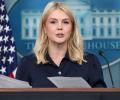
A White House official claims Donald Trump ended several conflicts, including the one between India and Pakistan, and deserves the Nobel Peace Prize. This claim is disputed by India.
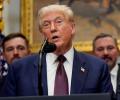
The United States announced a 25 per cent tariff on India as the White House released an expansive list of duties that Washington, DC will impose on exports from countries around the world.
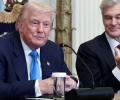
US President Donald Trump announced a deal with Pakistan to develop its oil reserves, suggesting Pakistan might sell oil to India in the future.
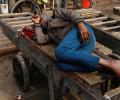
India is projected to grow at 6.4 per cent in fiscal year 2025 and 2026, and the country's stable growth is driven by a reform momentum supporting robust consumption growth and a push for public investment, the International Monetary Fund has said. The IMF released its World Economic Outlook (WEO) Update on Tuesday.
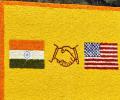
US President Donald Trump has said the trade deal with India is not finalised, as he stressed that India imposes more tariffs than almost any other country.
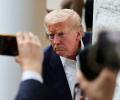
United States President Donald Trump has said the trade deal with India is not finalised, as he stressed that India imposes more tariffs than almost any other country.

A UN Security Council report states that The Resistance Front (TRF) claimed responsibility for the Pahalgam terror attack and published a photograph of the attack site. The report also cites assertions that the attack could not have happened without the support of Pakistan-based Lashkar-e-Tayyiba (LeT).
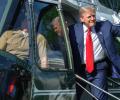
Thailand and Cambodia have for the third consecutive day witnessed clashes at the border that left over 30 dead and more than 1,50,000 displaced.
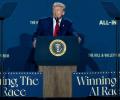
Trump signed three executive orders related to AI, including a White House action plan, an order that establishes a coordinated national effort to support the American AI industry by promoting the export of full-stack American AI technology packages.
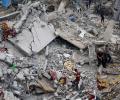
"Intermittent pauses in hostilities are not enough to address the scale of humanitarian challenges confronting the people, who grapple daily with acute shortages of food and fuel, inadequate medical services and lack of access to education," Harish said at the open debate on the 'Situation in the Middle East, including the Palestinian question'.
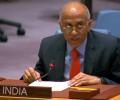
India's Permanent Representative to the UN Ambassador Parvathaneni Harish said that the Indian sub-continent offers a "stark contrast" in terms of progress, prosperity and development models.
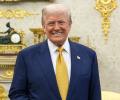
Trump, who has repeatedly said that he stopped the conflict between India and Pakistan through trade, last Friday said for the first time that "five jets were shot down" during the fighting.

US President Donald Trump claimed that "five jets were shot down" during the conflict between India and Pakistan in May and repeated his assertion that the fighting ended following his intervention. India has maintained that the two sides halted their military actions following direct talks between their militaries without any mediation by the US.
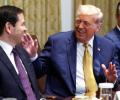
Rubio also listed the peace deal between the Democratic Republic of the Congo and Rwanda, 'a 12-day war that ended with an American operation that we're the only country in the world that could have done, hopefully pretty soon a peace deal between Azerbaijan and Armenia.'
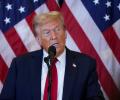
President Donald Trump on Tuesday claimed that BRICS was established to "hurt" the US and "degenerate" the dollar as he warned that the member countries of the bloc would face a 10 per cent tariff. Trump made the remarks while talking to reporters at the sixth Cabinet meeting at the White House.
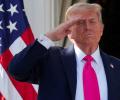
President Trump says the US is close to a trade deal with India, while also claiming to have stopped a war between India and Pakistan.
 © 2026 Rediff.com - Investor Information - Advertise with us - Disclaimer - Privacy Policy - Sitemap - Feedback - About us - Terms of use - Grievances